Peter Ayolov
Bio
Peter Ayolov’s key contribution to media theory is the development of the "Propaganda 2.0" or the "manufacture of dissent" model, which he details in his 2024 book, The Economic Policy of Online Media: Manufacture of Dissent.
Stories (87)
Filter by community
Living Scripts: When Cinema Becomes Therapy...
Cinema has always functioned as a mirror, but in certain films it becomes something far more unsettling: a stage where life is not merely reflected but reconstructed, rehearsed, and, in some cases, corrected. Joachim Trier’s *Sentimental Value* (2025) and Hirokazu Kore-eda’s *The Truth* (2019) belong to this rare category. Both films explore the same disturbing possibility—that art is not only an expression of life, but a substitute for it. More precisely, they reveal how artists, unable to communicate directly with those closest to them, begin to stage their own lives as a form of apology. In doing so, they transform cinema into a form of psychodrama, where the past is reenacted in the hope that it might finally be understood.
By Peter Ayolov3 days ago in Critique
The House Remembers
Joachim Trier’s Sentimental Value (2025) is a film that operates with deceptive simplicity. At first glance, it appears to be another entry in the lineage of European family dramas—restrained, introspective, concerned with memory and emotional estrangement. Yet beneath this familiar surface lies a far more intricate structure: a film about the impossibility of direct communication, and the desperate human tendency to replace speech with form, gesture, and performance. What Trier constructs is not merely a story about a broken family, but a meditation on how art becomes the last refuge of those who can no longer speak truthfully to one another.
By Peter Ayolov3 days ago in Fiction
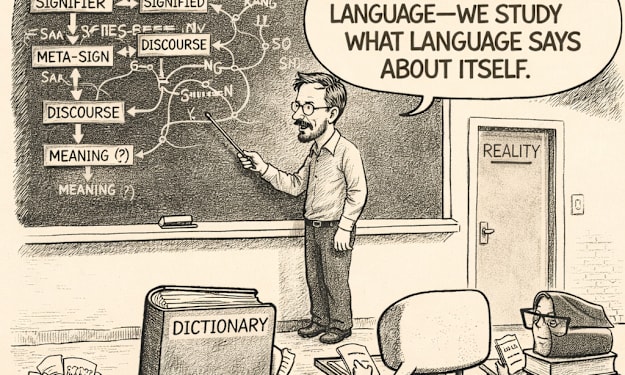
THE LANGUAGE OF LINGUISTICS
Review The Grammar That Consumes Itself: Linguistics at the Edge of Meaning The chapter ‘The Language of Linguistics’ from Part 6 ‘New Paradigm of Communication’ of THE MISCOMMUNICATION TRILOGY, ‘The Conspiracy of Speech, Vol. I.’ presents a dense and philosophically ambitious critique of linguistics as both a scientific discipline and a historical force that reshapes communication itself. It situates linguistics not merely as a neutral field of inquiry, but as a transformative meta-language that simultaneously clarifies and distorts the very phenomenon it seeks to explain. The chapter operates at the intersection of philosophy, communication theory, and linguistic history, advancing a central thesis: that the scientific study of language, while promising clarity and structure, ultimately contributes to the instability and obsolescence of meaning in contemporary communication systems. At the core of the chapter lies a fundamental paradox. Linguistics emerges as a discipline driven by the desire to stabilise language, to render it analyzable, predictable, and governed by rules. Yet this very act of systematisation produces an unintended consequence: the abstraction of language away from lived experience. Language, once embedded in social interaction, ritual, and context, is reconfigured into a system of categories—phonemes, morphemes, syntax—each designed to capture its internal logic. This transformation is not merely descriptive but constitutive. The act of analysing language changes its nature, creating a gap between theoretical models and practical communication that becomes increasingly difficult to bridge. The review must emphasise how the chapter frames this gap not as a temporary limitation but as an intrinsic feature of linguistic inquiry. The more linguistics refines its models, the further it distances itself from the fluidity of real communication. This tension between system and practice becomes the central axis around which the chapter unfolds. It is not a failure of linguistics but its defining condition: the discipline succeeds precisely by abstracting language, yet in doing so, it produces a form of knowledge that cannot fully return to the lived reality from which it emerged.
By Peter Ayolov3 days ago in BookClub
SPEAKING CONSPIRACY
Review The Closed Circuit of Meaning: A Review of Speaking Conspiracy The chapter ‘Speaking Conspiracy’ from Part 6 ‘New Paradigm of Communication’ (extended version) of THE MISCOMMUNICATION TRILOGY, ‘The Conspiracy of Speech, Vol. I.’ reconfigures language as a self-organising system whose patterns of repetition, alignment, and circulation generate a conspiratorial structure without the need for intentional conspirators. It stands as one of the most conceptually dense and theoretically ambitious segments within the broader architecture of the work, offering a sustained interrogation of language not as a neutral medium but as a self-organising system that increasingly operates beyond the intentions of its users. What distinguishes this chapter from more conventional critiques of discourse is its refusal to locate manipulation solely in institutions, elites, or ideological apparatuses. Instead, it advances a more unsettling thesis: that language itself, under contemporary conditions, behaves conspiratorially—not through hidden coordination, but through visible, repeated, and normalised processes of alignment, circulation, and self-reinforcement.
By Peter Ayolov3 days ago in BookClub
NEW PARADIGM OF COMMUNICATION
Review The Language That Consumes Itself: A Review of a Theory of Communicative Exhaustion This work presents an ambitious and wide-ranging attempt to rethink the role of language in contemporary society, advancing the provocative thesis that communication has entered a new historical phase defined by the planned obsolescence of language. At its core lies a diagnosis of a civilisation saturated by speech yet deprived of meaning, where language no longer accumulates understanding but circulates in ever-accelerating cycles of production and decay. The text situates itself within a long tradition of linguistic and philosophical critique, yet it extends this tradition by integrating insights from media theory, political communication, and the sociology of knowledge into a unified conceptual framework.
By Peter Ayolov4 days ago in BookClub
DEAD MEN'S UTOPIAS
Review Dead Men’s Utopias Dead Men’s Utopias by Peter Ayolov presents itself as the fifth part of Volume I, The Conspiracy of Speech, within THE MISCOMMUNICATION TRILOGY(The Planned Obsolescence of Language), yet its role within the structure of the work is more complex than a simple continuation. It is neither a conclusion nor a detached addition, but an expanded return to the beginning. The text revisits the foundational ideas of the opening part and rearticulates them in a broader, more elaborated, and conceptually intensified form. This repetition is not accidental and not redundant. It is structural. It reflects the very logic the book describes: that language persists, returns, and reshapes itself through accumulation rather than replacement. In this sense, the extended version is not simply longer; it is deeper, denser, and more recursive.
By Peter Ayolov7 days ago in BookClub
Empire After Empire: The Endgame Illusion
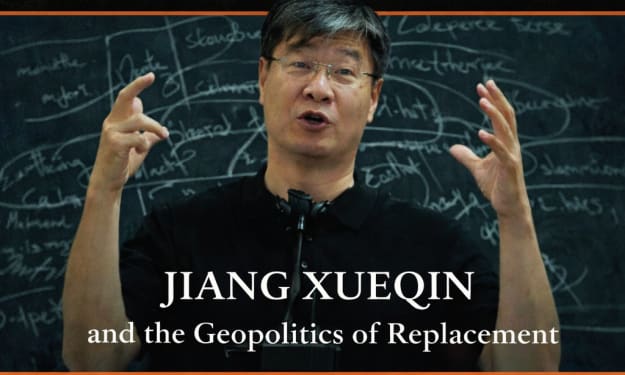
Empire After Empire: The Endgame Illusion (Jiang Xueqin and the Geopolitics of Replacement) In his lecture ‘Game Theory #16: Pax Judaica Rising’, Jiang Xueqin develops a provocative and highly speculative interpretation of how the war with Iran may end, not by fixing a date for its conclusion but by tracing the strategic logic that, in his view, already points towards its final shape. His central argument is that the United States is not simply struggling in a difficult war but revealing the deeper weakness of a declining empire. The problem, as he presents it, is not merely military. It is intellectual, political and civilisational. Washington entered the conflict assuming that overwhelming force, decapitation strikes and economic pressure would quickly bring surrender. Instead, the war has exposed a profound inability to adjust to resistance. The American state, its media system and its strategic class continue to speak as though victory were already achieved, even while the conditions of the conflict suggest the opposite. For Jiang, this gap between official certainty and strategic reality is the clearest sign of imperial hubris.
By Peter Ayolov14 days ago in Futurism
Peter Ayolov's Publications
Peter Ayolov is a media theorist and lecturer at Sofia University ‘St. Kliment Ohridski’, Faculty of Journalism and Mass Communication. His research focuses on the political economy of communication, propaganda models, digital media, narrative structures, and the transformation of language in contemporary technological environments. His work examines how digital communication systems organise dissent, amplify outrage, and reshape the relationship between media, public opinion, and political power.
By Peter Ayolov14 days ago in Education
The Return of History
Jiang Xueqin is an educator and thinker known for connecting game theory with broad civilisational and geopolitical analysis. In this argument, he develops a sweeping interpretation of global change, challenging the idea that the post-Cold War order represents a stable endpoint of history. He presents a stark vision of a world entering a new phase defined by instability, scarcity, and the need for resilience.
By Peter Ayolov15 days ago in Futurism
Overproduction of Words
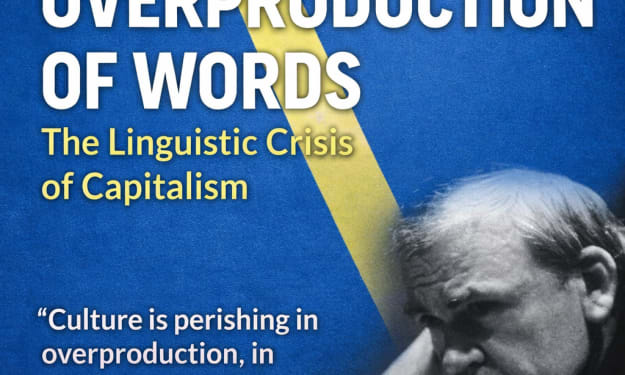
Peter Ayolov Sofia University "St. Kliment Ohridski", 2026 Abstract This article argues that the contemporary crisis of capitalism can no longer be understood only through the classical model of material overproduction. Drawing on the Marxist theory of crisis, especially the framework associated with P. K. Figurnov, it proposes that digital capitalism has displaced the contradiction of overproduction from the factory to language itself. In the age of artificial intelligence and large language models, words, narratives, arguments, and symbolic forms are produced at near-zero marginal cost and on an effectively unlimited scale. What follows is not an expansion of meaning, but its devaluation. As commodities once lost exchange-value when they could not be sold, language now loses meaning-value when it can no longer be absorbed, interpreted, or distinguished within an oversaturated symbolic market. The article develops this claim across four movements: the transformation of classical overproduction into linguistic overproduction; the collapse of intellectual value under AI automation; the need to oppose planned obsolescence with civilisational durability; and the ideological failure of accelerationist fantasies that confuse energy, speed, and scale with historical direction. It concludes that the deepest crisis of late capitalism is not simply economic, but superstructural: a breakdown of meaning, legitimacy, continuity, and symbolic order. Within this condition, Ayolov’s work is presented as one of the few contemporary attempts to map the totality of a decaying superstructure and the obscure emergence of a new one.
By Peter Ayolov16 days ago in Critique
THE RELIGION OF LITERATURE, THE MISCOMMUNICATION TRILOGY, “The Entropy of Communication, Vol. II”, Part 5
Review-The Religion of Literature Civilisation as Narrative: Literature, Belief, and the Entropy of Meaning The Religion of Literature is a wide-ranging and intellectually ambitious work that examines the role of narrative in shaping modern systems of belief, knowledge, and political legitimacy. Positioned within a broader theoretical framework concerned with the instability of communication, the book explores how language structures social reality through interpretative frameworks that increasingly resemble the symbolic authority once exercised by religion. Rather than approaching literature narrowly as artistic writing, the book expands the concept to include the entire textual infrastructure of modern culture: philosophical argument, political theory, historiography, scientific debate, and public discourse. Within this enlarged conception of literature, the book argues, societies construct the stories through which they understand truth, identity, and power.
By Peter Ayolov24 days ago in BookClub