
Why You Feel Sleepy But Can’t Sleep – And What Your Brain Is Really Doing
The frustrating 2 a.m. paradox, explained without the fluff.


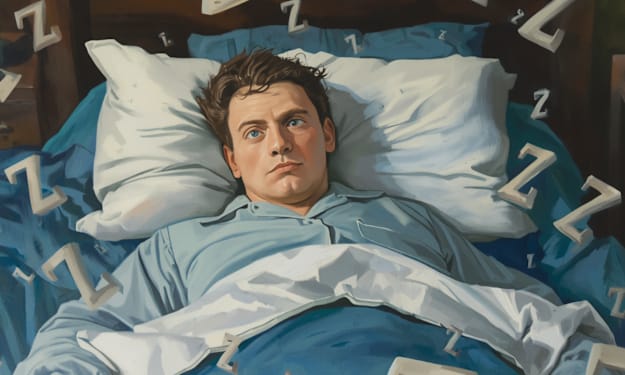
You know the feeling. It’s past midnight. Your eyes are heavy, your body is begging for rest, and you’ve been yawning for the last hour. You turn off the lights, close your eyes, and… nothing. Your mind starts racing. You check the clock. Then again ten minutes later. You feel exhausted but wired at the same time.
If this sounds familiar, you’re not broken. You’re just caught in a very common neurological trap. Let’s break down why this happens and how to get out of it.
---
Subtitle 1: The “Tired But Wired” State – A Modern Epidemic
At its core, feeling sleepy but unable to sleep means your body is sending one signal (sleep pressure) while your brain is sending another (alertness). Normally, these two systems work together. But in modern life, they often clash.
Think of it like this: your body is a car running on fumes, but your brain’s foot is still on the accelerator. You’re exhausted, but you can’t shut down.
This state is so common today that sleep scientists have a nickname for it: “hyperarousal.” It’s not just a bad habit – it’s a physiological condition where your nervous system stays stuck in low-key “fight or flight” mode, even when you’re physically drained.
Why does this happen more now than 50 years ago? Because our environment has changed faster than our biology. Your ancient brain can’t tell the difference between a predator in the bushes and an angry email from your boss. Both trigger the same stress response.
---
Subtitle 2: The Usual Suspects – Blue Light, Caffeine, and Late Nights
Let’s start with the obvious ones, because they’re still the biggest culprits for most people.
Blue light from screens is a major player. Your eyes have special cells that detect blue wavelengths – the kind that come from the sun in the morning. When you stare at your phone or laptop at 11 p.m., those cells tell your brain: “It’s still daytime. Stop making melatonin.” Melatonin is your natural sleep hormone. Without it, you feel drowsy but can’t cross the line into deep sleep.
Caffeine is another obvious but sneaky factor. Its half-life is about 5-6 hours. That means if you have a coffee at 4 p.m., half of it is still in your system at 9-10 p.m. But even more deceptive: caffeine blocks adenosine, the chemical that builds up “sleep pressure” throughout the day. You might feel sleepy because your body is tired, but the caffeine is actively blocking the switch that would let you fall asleep.
Late-night eating can also be a problem. A heavy meal before bed forces your digestive system to work overtime, which raises your core body temperature. Sleep requires your core temperature to drop slightly. A hot, active stomach works against that.
But here’s the thing: most people already know this. And they still can’t sleep. So what’s really going on?
---
Subtitle 3: The Hidden Culprit – Your Brain’s “Second Wind”
Have you ever felt completely exhausted at 9 p.m., but then strangely alert at 11 p.m.? That’s not your imagination. It’s called the “forbidden zone for sleep.”
Your brain has an internal clock – the circadian rhythm. It releases alertness signals during the day and sleep signals at night. But around 9-10 p.m., your body naturally produces a small spike in alertness before the main sleep phase. For most of human history, this was useful – a final check for safety before settling down.
But today, we misinterpret that spike. You feel that little wave of energy and think, “Oh, I’m not tired anymore. Maybe I’ll watch one more episode.” Then an hour later, you’ve missed your optimal sleep window, and now you’re stuck in the high-alert zone until 2 a.m.
This is why “sleep hygiene” advice like “just go to bed earlier” fails for so many people. You’re not failing at sleep – you’re fighting your own biology at the wrong time.
---
Subtitle 4: The Anxiety Loop – Why Trying Harder Makes It Worse
Here’s the most frustrating part: the more you try to sleep, the more awake you become.
Think about it. When you’re lying there, thinking “I need to fall asleep or tomorrow will be a disaster,” your brain treats that as a threat. It releases cortisol and adrenaline – the same chemicals that would help you run from danger. Your heart rate goes up. Your muscles tense. Your mind scans for “solutions” (like checking the time or changing positions).
That’s the opposite of what you need for sleep. Sleep requires letting go. Trying is the enemy.
This creates a vicious loop:
· You feel tired but can’t sleep.
· You start worrying about not sleeping.
· Worrying triggers stress hormones.
· Stress hormones keep you awake.
· Now you’re even more worried.
Within 20 minutes, you’ve gone from “a bit restless” to “fully alert and anxious.” And the worst part? You start associating your bed with frustration. Over time, your bed becomes a trigger for wakefulness instead of rest.
---
Subtitle 5: The Racing Mind – How Thoughts Hijack Sleep
Another huge reason people feel sleepy but can’t sleep is unfinished mental business. Your brain doesn’t have an “off” switch. When you lie down in the dark with no distractions, your default mode network (the part of the brain active during daydreaming and self-reflection) kicks into high gear.
Suddenly, you remember that thing you forgot to do at work. Then you think about that awkward conversation from three days ago. Then you start planning tomorrow’s to-do list. This isn’t a personal failing – it’s how your brain processes information when external input drops to zero.
For people with high-stress jobs, anxiety, or even just a busy life, this can be overwhelming. The physical tiredness is real. But your mental engine is still revving at 5,000 RPM. You’re sleepy in your body, but wide awake in your head.
This is why many experts say: “You can’t solve a racing mind with more effort.” You have to redirect it, not fight it.
---
Subtitle 6: Quick Fixes That Actually Work (No Meditation Required)
Let’s skip the generic “try deep breathing” advice. You’ve heard it. Instead, here are three counterintuitive methods that work for real people.
1. Get out of bed. Seriously.
If you’ve been lying there for 20-30 minutes and you’re not asleep, get up. Go to another dark, boring room. Sit on a couch. Read a physical book (no screens). Only go back to bed when you feel genuinely drowsy – not just tired, but actually struggling to keep your eyes open. This breaks the anxiety association with your bed.
2. Do the “cognitive shuffle.”
Pick a random letter, say “T.” Then think of words that start with T: table, tiger, toaster, telephone. Then move to “S.” Keep going. This is boring enough to quiet your mind but engaging enough to stop anxious thoughts. It mimics the random images your brain produces right before sleep.
3. Use paradoxical intention.
Tell yourself: “I am going to stay awake with my eyes open. I will not close them.” Lie there and try as hard as you can to keep your eyes open. Within a few minutes, your eyes will get heavy. Why? Because you’ve removed the pressure. You’re no longer trying to sleep – you’re trying to stay awake. And your brain, being contrary, will do the opposite.
These sound silly, but they work because they break the anxiety loop.
---
Subtitle 7: When It’s Not Just a Phase – Knowing When to Get Help
Occasional sleeplessness is normal. But if you’ve been feeling sleepy yet unable to sleep most nights for more than three months, you may have chronic insomnia. And that’s not a willpower issue – it’s a medical condition.
See a doctor if:
· You regularly lie awake for over an hour.
· You wake up at 3 a.m. and can’t go back to sleep.
· You feel exhausted during the day no matter how long you “tried” to sleep.
· You’ve tried good sleep hygiene for weeks with no improvement.
There are effective treatments, especially CBT-I (Cognitive Behavioral Therapy for Insomnia), which has a success rate of 70-80% – higher than sleeping pills. And no, it’s not just “think positive.” It’s a structured program that retrains your brain’s sleep response.
---
Subtitle 8: The Bottom Line – Stop Fighting, Start Surrendering
The biggest shift you can make is this: stop treating sleep as a task. You don’t “achieve” sleep. You don’t earn it. Sleep is not a performance. It’s a state of letting go.
When you feel sleepy but can’t sleep, the problem is rarely a lack of tiredness. It’s almost always an excess of effort. You’re trying too hard. You’re caring too much. And that caring is exactly what’s keeping you awake.
So tonight, if it happens again, try this: say to yourself, “Okay, I’m not sleeping. That’s fine. I’ll just rest here. Lying down with my eyes closed is still rest. My body is recovering anyway.”
Remove the demand. Remove the deadline. Remove the panic. And often – not always, but often – sleep will slip in through the back door while you weren’t looking.
Because the secret to falling asleep when you’re exhausted… is to stop trying to fall asleep at all.
About the Creator
Health Looi
Metabolism & Cellular Health Writer. I research and write about natural health, :mitochondrial support,and metabolic wellness .More health guides and exclusive content:
https://ko-fi.com/healthlooi
Keep reading
More stories from Health Looi and writers in Longevity and other communities.
The Real Reason You Keep Waking Up Tired (It’s Not Just Lack of Sleep)
You set your alarm for a solid 8 hours. You put on your silk eye mask, sip your chamomile tea, and drift off at a reasonable hour. Then morning comes — and you feel like you’ve been hit by a truck. Your brain is foggy, your body is heavy, and that first coffee doesn’t even make a dent.
By Health Looia day ago in Longevity
Microsoft's Purposeful Marketing Deception About AI's Ability To Beat Physicians In Diagnosis
When you look at the world of scientific research... If you are not careful... You will be fooled into believing things that are not actually supported by the data.
By Dr. Cody Dakota Wooten, DFM, DHM, DAS (hc)26 days ago in Longevity
Kaizen
How Tiny Daily Changes Create Massive Transformation Over Time THE REVOLUTION THAT WHISPERS Western culture worships dramatic transformation, the overnight success story, the complete life overhaul, the radical reinvention that turns everything around in a single decisive moment, and this worship of dramatic change is precisely why most people fail to change at all, because the gap between where they are and where they want to be seems so vast that the only response that feels adequate is a massive effort that is unsustainable by definition, and after the initial burst of motivation fades, which research shows happens within an average of two to three weeks, the old patterns reassert themselves and the person is left not just back where they started but demoralized by another failed attempt at transformation, and this cycle of dramatic effort followed by inevitable collapse followed by deepened despair is the defining pattern of Western self-improvement culture, and the Japanese philosophy of kaizen offers an alternative so simple it seems almost insulting, so gentle it seems almost lazy, and so effective it has been adopted by the world's most successful corporations, the world's most elite athletes, and the world's longest-lived cultures as the foundational principle of sustainable improvement.
By The Curious Writer8 days ago in Longevity
Kristi Noem is MELTING!!!!!
Former Homeland Secretary/"Ice Barbie" Kristi Noem is melting with scandals, not she is dealing with a cheating affair with one of the aides, killing her puppy, her own supportive husband Byron Noem is being exposed as a crossdresser, talking with fetish's Bimbos and paying them thousands of dollars. Kristi Noem's husband was exposed by the Dailymail this week exposing photos of Byron wearing and flaunting big gigantic balloon faux ta-tas, wearing paded shorts, and pouting his duck lips like it's 2013.
By Gladys W. Muturi5 days ago in The Swamp



Comments
There are no comments for this story
Be the first to respond and start the conversation.