
HVAC Equipment Market Outlook: Energy Efficiency Demand and Growth Opportunities
The HVAC Equipment Market is experiencing strong growth driven by increasing demand for energy-efficient heating, ventilation, and air conditioning systems across residential, commercial, and industrial sectors.

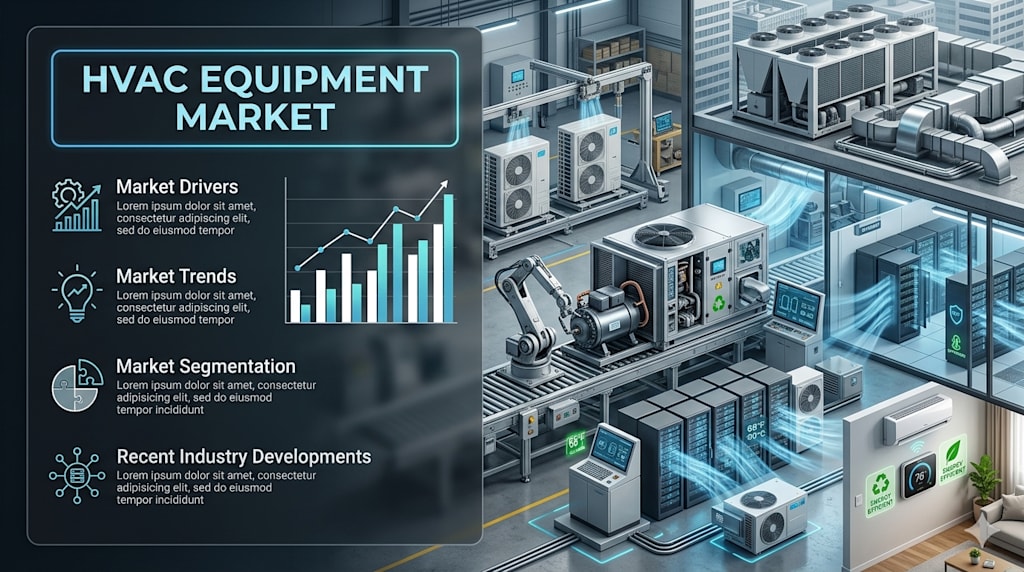
According to IMARC Group's latest research publication, The global HVAC equipment market size was valued at USD 242.7 Billion in 2025. Looking forward, IMARC Group estimates the market to reach USD 364.2 Billion by 2034, exhibiting a CAGR of 4.47% from 2026-2034.
How AI is Reshaping the Future of HVAC Equipment Market
- Predictive Maintenance and Failure Prevention: Machine learning algorithms analyze equipment performance data to identify anomalies indicating impending failures 2 to 4 weeks in advance. Systems monitor motor vibrations, energy consumption patterns, and temperature differentials, reducing maintenance costs by 40 percent and decreasing unexpected equipment failures by 90 percent while preventing costly emergency repairs.
- Smart Energy Optimization and Demand Response: AI-driven platforms automatically participate in utility demand response programs by pre-cooling buildings before peak hours and reducing loads during expensive rate periods. Intelligent systems can cut energy consumption by up to 40 percent while maintaining occupant comfort through real-time adaptive control, processing decisions in 1 to 2 seconds directly at device level.
- Occupancy-Based Climate Control: Advanced sensors and predictive analytics learn from occupancy patterns and weather data to automatically adjust temperatures for maximum efficiency. AI-powered thermostats like Nest, Ecobee, and Honeywell reduce energy usage by 10 to 15 percent by regulating temperature based on system usage, user behavior, and real-time occupancy detection across residential and commercial buildings.

HVAC Equipment Industry Overview
The U.S. Energy Efficient Home Improvement Credit provides homeowners tax credits up to USD 3,200 annually through December 2025, covering 30 percent of costs for qualifying heat pumps (up to USD 2,000), air conditioners (up to USD 600), and furnaces (up to USD 600). The High-Efficiency Electric Home Rebate Program offers point-of-sale rebates up to USD 8,000 for low-income households and USD 4,000 for moderate-income households, accelerating adoption of energy-efficient HVAC technologies across residential and commercial sectors.
HVAC Equipment Market Trends & Drivers
Rising construction activity and urbanization are powering HVAC equipment demand across residential and commercial sectors worldwide. Buildings consume approximately 40 percent of global energy, with HVAC systems representing the largest portion of that consumption. Rapid urbanization adds roughly 1.2 billion square meters of new commercial floor space annually in Asia-Pacific nations including India, Indonesia, and Vietnam, where cooling loads exceed 200 watts per square meter. North America holds the largest market position, driven by thriving construction sectors and replacement demand from aging infrastructure. The U.S. central air conditioning market projected unit shipments growing from 7.8 million units in 2024 to 11 million units by 2030.
Government regulations and energy efficiency mandates are reshaping market dynamics and accelerating technology upgrades. The European Union Renovation Wave and updated Energy Performance of Buildings Directive mandate all new buildings reach net-zero status by 2030, forcing commercial assets to achieve EPC class C ratings. Europe held 26 percent market share in 2024, accelerating heat-pump retrofits to satisfy stricter standards. Japan's F-Gas Law requires annual leak checks on systems over 5 kilograms refrigerant charge, pushing wireless sensor deployments across shopping malls and hotels.
Smart technology integration and IoT connectivity are transforming HVAC from reactive to autonomous systems. Over 70 percent of U.S. households are expected to have AI-powered smart thermostats by 2025. Smart HVAC systems collect data from sensors throughout buildings, sending information to cloud platforms for analysis and enabling automatic performance adjustments based on real-time conditions. Digital ordering platforms and smartphone apps allow remote monitoring and control, while machine learning personalizes settings based on user habits. By 2025, over 40 percent of new commercial buildings in the U.S. integrate renewables with AI-driven HVAC systems.
Leading Companies Operating in the Global HVAC Equipment Industry
- Carrier Global Corporation
- Daikin Industries Ltd.
- Danfoss AS
- Emerson Electric Co.
- Honeywell International Inc.
- Johnson Controls International
- Lennox International Inc.
- LG Electronics Inc.
- Mitsubishi Electric Corporation
- Panasonic Holdings Corporation
- Samsung Electronics Co. Ltd.
- Trane Technologies plc
- Whirlpool Corporation
HVAC Equipment Market Report Segmentation
By Type
- Heating
- Air Conditioning
- Ventilation
- Others
Air conditioning represents the largest segment, reflecting widespread demand across residential, commercial, and industrial sectors driven by rising global temperatures and increasing need for climate control in diverse environments.
By System Type
- Central
- Decentralized
Based on the system type, the market has been segmented into central and decentralized.
By End User
- Residential
- Commercial
- Industrial
Commercial accounts for significant market share owing to growing demand for sophisticated climate control systems in offices, hospitals, shopping centers, educational institutions, and hospitality facilities prioritizing occupant comfort and energy efficiency.
Regional Insights
- North America (United States, Canada)
- Asia Pacific (China, Japan, India, South Korea, Australia, Indonesia, Others)
- Europe (Germany, France, United Kingdom, Italy, Spain, Russia, Others)
- Latin America (Brazil, Mexico, Others)
- Middle East and Africa
North America enjoys the leading position owing to large market for HVAC equipment driven by thriving construction sector, high replacement demand, and strong emphasis on energy-efficient technologies.
Recent News and Developments in HVAC Equipment Market
- January 2025: LEADING Electric & Machinery Co., Ltd. and Hotai Development Co., Ltd., its Taiwanese distributor, formed a joint venture with Daikin Malaysia Sdn. Bhd., beginning operations to produce air handling units for Taiwan. The partnership merges LEADING's AHU product expertise with support features developed for semiconductor applications, targeting the growing regional demand for specialized industrial HVAC solutions.
- May 2024: Samsung and Lennox announced formation of Samsung Lennox HVAC North America joint venture. The partnership focuses on selling ductless mini-split air conditioning, heat pump, and VRF systems throughout the United States and Canada. The collaboration combines Samsung's electronics expertise with Lennox's distribution network to expand market presence in residential and light-commercial segments.
- July 2024: Bosch acquired Johnson Controls-Hitachi's residential and light-commercial HVAC unit to expand its heating, ventilation, and cooling portfolio. The acquisition includes manufacturing plants and product lines for boilers, heat pumps, and climate control systems, strengthening Bosch's position in the European and North American markets with enhanced technology capabilities.
- February 2024: Daikin Industries launched comprehensive data center solutions at Datacenter World, consisting of airside and chiller solutions specifically designed for data centers and post-sale facilities. The launch addresses surging demand from AI data centers requiring sophisticated cooling systems to manage high-density computing loads while maintaining energy efficiency standards.
- March 2024: Johnson Controls, in collaboration with Mahindra Group, announced expansion of a third manufacturing unit in Pune, India. The new facility produces air-cooled and water-cooled chillers for wide-ranging applications including data centers, commercial buildings, and industrial facilities, supporting growing South Asian market demand.
- February 2024: ABB India launched the ACH180 compact drive designed for HVACR systems at ACREX 2024. This energy-efficient drive enhances motor control, reduces energy consumption, and supports various applications, aligning with sustainability goals and improving operational efficiency in commercial buildings across emerging markets.
- August 2024: Johnson Controls Hitachi Air Conditioning introduced the air365 Max Pro and air365 SideSmart in Hong Kong, featuring advanced energy efficiency technologies. The systems incorporate intelligent controls and low-GWP refrigerants, targeting premium residential and commercial markets focused on environmental performance and operating cost reduction.
- November 2025: Johnson Controls signed a 15-year, USD 120 million energy-savings contract with a U.S. university system, guaranteeing 25 percent HVAC energy reductions. The performance-based agreement demonstrates growing institutional adoption of outcome-based service models that transfer energy efficiency risk from building owners to equipment manufacturers and service providers.
Note: If you require specific details, data, or insights that are not currently included in the scope of this report, we are happy to accommodate your request. As part of our customization service, we will gather and provide the additional information you need, tailored to your specific requirements. Please let us know your exact needs, and we will ensure the report is updated accordingly to meet your expectations.
About the Creator
Michael Richard
Michael Richard is a Market Research Expert specializing in market intelligence, competitive analysis, and data-driven insights. He helps organizations understand trends and emerging opportunities through in-depth research.
Keep reading
More stories from Michael Richard and writers in Futurism and other communities.
Battery Recycling Market Outlook: Sustainable Resource Recovery and Growth Opportunities
According to IMARC Group's latest research publication, The global battery recycling market size was valued at USD 18.0 Billion in 2025. Looking forward, IMARC Group estimates the market to reach USD 32.9 Billion by 2034, exhibiting a CAGR of 6.74% from 2026-2034.
By Michael Richardabout 5 hours ago in Futurism
How machines can learn from human behaviour
In order to understand where we are and where we are going, we need to understand where we were first. - Susan Fourtane Could a human behaviour simulator be embedded into a robot or online avatar to the point that it’s hard to distinguish between a real person or artificial intelligence? Scientists have been upping the stakes in this “Turing test” for years, to the point that human-mimicking programmes are ready to answer tricky questions, assist people with online shopping or be companions.
By Susan Fourtané 22 days ago in Futurism
What is VPS Hosting and When Should a WordPress Website Upgrade to It
My WordPress website ran on shared hosting for the first two years without any noticeable problems. Traffic was low, the pages loaded at an acceptable speed, and the cost was easy to justify. Then something changed. A blog post picked up traction on social media and traffic spiked overnight. The website slowed to a crawl. Pages that used to load in 2 seconds were taking 8 or 9. Some visitors were getting timeout errors. By the time the traffic spike passed, I had already lost a significant portion of the audience I had just gained.
By Edward D. Longfellow5 days ago in Futurism



Comments
There are no comments for this story
Be the first to respond and start the conversation.