
AI: From “Talking Encyclopedia” to Digital Employee. Do You Really Need Your Own Agent? 🤖
Why your chatbot is finally getting a job—and whether you should hire it.

Turn on the TV, open a news portal, and you see the same thing everywhere: Artificial Intelligence (AI). It feels like the world has gone mad, and every person on the planet is sipping coffee with ChatGPT in the morning and asking algorithms to write poetry by evening. ☕📜
However, reality is much more grounded. The statistics are unforgiving: the vast majority of people in the world have never typed a single command into an AI chat box. Even more telling, among those who have tried it, only a small minority actually knows how to use it correctly. Most of us treat AI as a curiosity—a toy that occasionally says something smart but sometimes completely hallucinates a recipe for a cake made of sand. 🥪🏖️
But technology doesn't stand still. Right now, we are moving from the era of "question and answer" to the era of AI Agents. If you thought chatbots were the peak of technology, buckle up, because a major shift is coming! 🏎️💨
What Exactly Is an AI Agent? 🤔
Imagine the difference between an encyclopedia and a personal assistant.
When you use a standard chatbot (like the basic version of ChatGPT), you are using a very smart digital book. You ask a question, it generates text. Its role ends there. It waits for you to type something again. It is what we call a reactive system—it only acts when you "pull its string." 📚🗨️
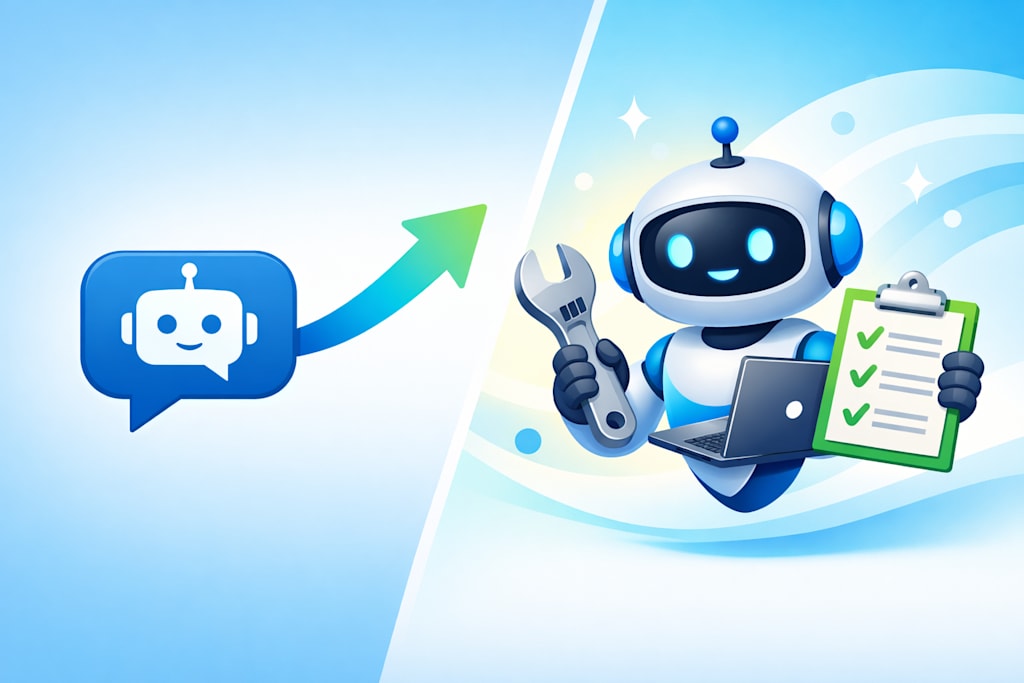
An AI Agent is a completely different beast. It’s a program that doesn't just "know"—it "acts." An Agent has a specific goal. Instead of just writing about how to do something, it simply rolls up its sleeves and gets to work. It can manage your emails, schedule your calendar, shop online, or analyze data in a company spreadsheet by connecting to various apps without your constant supervision. 🛠️📅
Chatbot vs. Agent – Spot the Difference ⚔️
Instead of a complicated technical table, let’s look at the specific traits that separate these two worlds:
Mode of Operation: A regular chatbot primarily answers questions and generates text. An AI Agent performs real-world tasks and uses specific tools to get them done. ⚙️
Initiative: A chatbot waits for your move (it’s reactive). An Agent plans its own steps to reach the goal you set for it (it’s proactive). 🏃♂️
Capabilities: A chatbot is mostly limited to text and images. An Agent can "step outside" the chat window—it can operate your email, your web browser, or your Excel sheets. 📧📈
Real-Life Example: A chatbot will write you a nice itinerary for a trip to Rome. An Agent will not only write it but will immediately check and book the flights, the hotel, and buy your tickets to the Colosseum. ✈️🏛️
How Does an Agent Work in Practice? 💼
The best way to understand an Agent is through a simple office example. Let’s say you want to organize a business meeting for five people.
With a standard chatbot: You have to ask it to write an invitation, then you manually copy that text and send it to everyone individually. Then, you have to monitor the replies yourself and manually look for a free slot that fits everyone’s schedule. That’s a lot of clicking, right? 🖱️📩
With an AI Agent: You give it one simple command: "Organize a meeting with Team X next Tuesday." The Agent checks your calendar, sends emails to the participants, analyzes their replies, picks a time that works for everyone, reserves a room in the system, and adds the meeting to your schedule. Finally, it sends you a short notification: "All set, see you at 2:00 PM." ✅🎯
An Agent can even "think." If it hits a snag (like a key person not replying to an email), it doesn't just give up. It tries another way or sends a polite follow-up reminder on its own.
Does the "Average Joe" Really Need an Agent? 🧐
This brings us to the big question—and you’re right to be skeptical: Not everyone needs an AI Agent, just like not everyone needs a private jet. 🛩️🚫
There is currently a massive "hype" surrounding AI. Tech companies are trying to convince us that we won't survive until Monday without a digital assistant. But let’s look at this realistically:
Who is this for? It’s for people genuinely overwhelmed by "digital bureaucracy." If you spend hours replying to hundreds of emails, managing a complex calendar for multiple people, or analyzing mountains of data, an Agent will be a lifesaver. You will get hours of your life back. ⏳👋
Who is it just a fancy gadget for? If your online activity is limited to checking sports scores, watching YouTube, and posting on Facebook, an AI Agent is like using a sledgehammer to crack a nut. Trying to "implement" it into your life will take you more time than the Agent will ever save you. 🪰💥
Most of us manage our lives just fine without the help of complex executive algorithms. It’s also worth remembering security—giving a program full access to your email or bank account is a serious decision that requires a level of trust and tech-savviness that most of us (for now) are still developing. 🔐
Summary 🏁
Artificial Intelligence is moving past being just a "talking head." AI Agents are a giant leap forward—a transition from words to actions. It’s a fascinating technology that will revolutionize office work, but for the average person, it will likely remain a curiosity behind a glass window for a while longer. 🪰🔍
Is it worth knowing they exist? Absolutely! Do you need to run out and install your own Agent today? Probably not. First, it’s worth mastering the basics. If you can’t effectively ask an AI to write a simple email, handing it the keys to your entire digital world might end in a bit of a mess. 🌪️
In the world of tech trends, haste is a poor advisor. The "Average Joe's" common sense is the most valuable filter we have. Let’s use technology wisely, not just because it’s fashionable! 💡🌟
About the Creator
Piotr Nowak
Pole in Italy ✈️ | AI | Crypto | Online Earning | Book writer | Every read supports my work on Vocal
Keep reading
More stories from Piotr Nowak and writers in Futurism and other communities.
The Lunar Joke That Became Reality: Artemis 2 is Already There! 🚀
Everything coincided with April Fools' Day, so I wasn’t a hundred percent sure at first, but now I know: Artemis 2 has flown! 🛰️ It’s truly fascinating how thin the line has become between monumental historical events and internet memes.
By Piotr Nowaka day ago in Futurism
The Fears of AI And How Much Fun It Can Be
ChatGPT has come a long way, as has AI in general. There are those people who are scared of it, and for understandable reasons. People fear that as technologies advance, they’ll be replaced in the workforce. Then, there are the fears that AI could evolve into something that brings us to the brink of extinction.
By Jason Morton10 days ago in Futurism
Nanoceramic Powder Market Reflects Remarkable Growth 14.1%
Market Overview The global nanoceramic powder market is projected to grow from USD 4.5 billion in 2025 to around USD 16.8 billion by 2035, registering a powerful CAGR of 14.1% between 2026 and 2035. This acceleration is driven by surging demand from electrical and electronics, electric vehicles (EVs) and transportation, and advanced industrial and medical applications that require materials with superior strength, thermal stability, and functional performance at the nanoscale.
By Hayden Kulas3 days ago in Futurism




Comments
There are no comments for this story
Be the first to respond and start the conversation.