
The Zenith
Where Honesty Buries Its Own

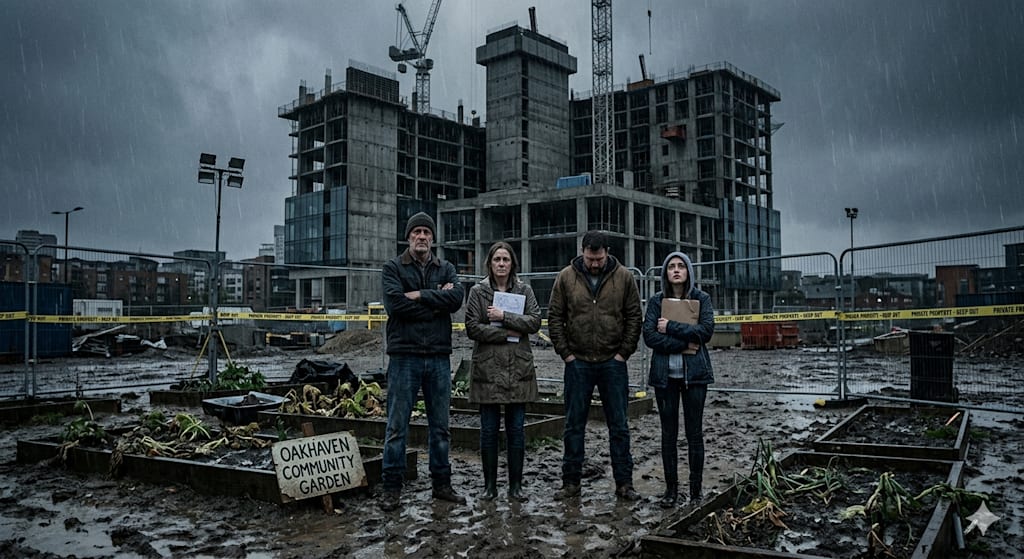
The rain in Oakhaven didn’t wash things clean; it just turned the town’s secrets into a thick, grey sludge.
Elias Thorne stood in the center of the derelict community garden, his boots sinking into the sodden earth. Beside him stood his three closest allies: Sarah, a former schoolteacher with kind eyes; Julian, a local carpenter who believed in the weight of a handshake; and Maya, a young idealist who thought the law was a shield rather than a weapon.
They were the last of a group of residents trying to protect the Valley District from being swallowed by "The Zenith"—a predatory redevelopment project.
"We have the signatures, Elias," Maya said, clutching a water-damaged folder. "The injunction is solid. They can’t break ground if the soil hasn’t been cleared for toxicity. We’ve won."
Elias looked out, where the neon glow of the city bled into the clouds. "We haven't won until the the bulldozers stay silent forever."
Elias was a man who believed in the inherent goodness of people. He believed that honest people, working for the common good, could withstand corporatization. It was a beautiful philosophy, but also his death warrant.
Two miles away, in a penthouse that smelled of expensive leather, and arrogance Marcus Vane swirled a glass of Scotch. Marcus was the architect of The Zenith, a man whose narcissism was so profound he viewed other humans as merely obstacles.
Sitting across from him was his associate, Silas Vance the Fixer—a man with a smile like a razor blade and a soul like a sinkhole. They didn't like each other; they tolerated one another. They were two predators sharing a carcass.
"The Thorne group filed the injunction," Silas said, his voice a low rasp. "They think the toxicity reports will stall us for six months; when our funding dries up."
Marcus stared. "Then the reports need to change, and the people holding them need to understand the cost of honesty."
"Elias has three people with him," Silas noted. "They’re tight. Loyal."
"Loyalty is just a lack of better options," Marcus spat. "They're playing a game with rules, Where we write the outcomes. If the law stops us, we move outside it. If the truth impedes us, we bend it, until it's ours."
Marcus didn't want money—he already had it. He wanted to pad his ego. He wanted Oakhaven as a monument to his dominance. Silas, on the other hand, just wanted the violence. Together, they were a closed circuit of greed and malice.
The first blow didn't come from a fist; it came from a pen.
The next morning, Sarah arrived at the community center to find the locks changed, and a city clerk there to serve a notice for "misappropriation of public funds" related to the garden. It was a baseless, fabricated charge, but in Oakhaven, a headline is as powerful, as a verdict.
"They're trying to discredit us," Sarah told Elias, her voice trembling. "My reputation... ten years of teaching, Elias. It’s gone in one morning."
"We fight it in court, with the truth," Julian growled.
But the truth was a slow runner, and Vane owned the track.
By noon, Julian’s carpentry shop was swarming with "inspectors" sent by a department Marcus had bought through campaign contributions. They found "violations" that didn't exist and shuttered his business.
By evening, Maya was gone.
She hadn't been kidnapped in the cinematic sense. She'd been intercepted by Silas. He didn't hurt her. He simply sat her down and showed her photos of her younger brother at College. He showed her the debt records of her parents. Then, he offered her a choice: sign a statement saying Elias had coerced her into forging the toxicity signatures, or watch her family dissolve into poverty and scandal.
Maya broke. Not because she was weak, but because Marcus and Silas knew exactly how to weaponize her love against her.
Elias sat in his kitchen, the silence of the house pressing against his ears. His phone was dead. His friends were scattered. Sarah was hiding from the press; Julian was drinking away his sorrows; and Maya... she was the star witness for the other side.
The front door kicked open.
It wasn't the police. It was Silas. He walked in with the casual air of a man entering his own home. He wasn't carrying a weapon, just a leather-bound folder.
"Marcus wants you to see the new blueprints," Silas said, tossing the folder onto the table.
Elias didn't look at it. "You’ve destroyed four lives for a shopping complex."
"No," Silas laughed. "We destroyed four lives for the greater good of society. Marcus finds your 'woke' ideals offensive. It’s a challenge to his reality. He wanted to prove that your 'righteous cause' was nothing compared to American Capitalism.
"The truth will come out," Elias whispered.
"The truth is, whatever we say it is," Silas replied.
He then leaned in, his breath smelling of peppermint and rot. "Tonight, the garden burns, and because Sarah’s fingerprints are on gas cans we planted there, she’s going to prison. Unless, of course, you take the fall."
Elias Thorne surrendered. He confessed to crimes he didn't commit to save Sarah from a cage. He watched from a holding cell as the news broadcasted the "Greed of the Valley Guard," a narrative constructed by Marcus Vane's PR team.
The community garden, was bulldozed under the cover of night. Not because the legal path cleared, but because Marcus simply paid the fines for "accidental" demolition. The fines were a fraction of the profit. To him the law was just a transaction fee.
Months later, the Zenith rose. It was a glass-and-steel monstrosity that blocked the sun from the lower streets of Oakhaven.
Sarah moved away, she couldn't look her neighbors in the eye. Julian lost his home and disappeared into the grey fog of the city’s outskirts. Maya lived in a high-rise apartment paid for by Marcus, a golden cage for her silence, her eyes forever hollow.
Elias remained in prison. There was no appeal. No hero came to save him.
Marcus Vane and Silas Vance stood on the observation deck of the completed Zenith tower.
"Look at that," Marcus said, gesturing to the shadow the building cast over the town. "It’s perfect."
"Thorne's group?" Silas asked.
"Who?" Marcus replied, genuinely having forgotten the names of the people he ruined. To him, they weren't enemies; they were just friction. And he eliminates friction.
Below them, the town was darker, behind the Zenith. The "peaceful" had been crushed, not by a greater force, but by a more ruthless one. The dishonest hadn't just won; they had rewritten the world in their image, because everyone else was too busy to notice or care.
Serpent’s Feast
The air at the summit of The Zenith was thin, tasting like metallic of impending rain. Marcus stood at the edge of the observation deck, his back to the world he had just conquered. To him, Oakhaven below was no longer a town; it was a chess board he had finally mastered.
"Look at them, Silas," Marcus said, his voice smooth as polished marble. "The ants are finally quiet. No more gardens and community activists. Just progress."
Silas stood five paces behind him. He wasn't looking at the view. He was looking at the back of Marcus’s head, where his skull met the spine. In his hand, Silas held a leather-bound ledger—the very one that contained the real toxicity reports, the payoff logs to the city council, and the recorded "confessions" that had sent Elias to prison.
"Progress is expensive, Marcus," Silas said. His voice was a low hum.
"And worth every penny," Marcus laughed. He spread his arms wide, a savior in a three-thousand-dollar suit. "We’re the only ones left standing. Your loyalty... made it all possible. I’m increasing your share by five percent."
Silas didn't smile. He just stared. "Five percent, that's a lot of money, Marcus. But money is just paper. Power is the hand that holds the match."
Marcus’s expression shifted, the edges of his arrogance fraying. "What are you talking about?"
"You think you’re the architect," Silas said, stepping closer. The rain began to fall in earnest now, slicking the marble floor. "But an architect just draws the lines. I’m the one who dug the holes. I know where the foundation's soft. I know which pillars were poured with more sand than cement to save you those 'transaction fees.'"
Marcus felt a coldness that had nothing to do with the wind. "Silas, we’re a team. We’re the same."
"No," Silas whispered, stopping inches from Marcus. "You’re a narcissist. You need the building to have your name on it. You need the world to see you. I’m a ghost. I don’t need anything, but to eat."
Silas reached into his coat and pulled out a small, encrypted drive. "This is the 'kill switch' for The Zenith’s offshore funding. And the ledger? It’s already been scanned and sent to the Feds. Not for justice—I don't care about Elias—but for leverage. I’ve already negotiated my immunity. In exchange, I give them the man who ordered it all. The man who forged the reports. You."
Marcus lunged, his face twisting into desperate rage. But Marcus was a man of boardrooms; Silas was a man of shadows. Silas caught Marcus’s wrist with a sickening crunch. He leaned in, his eyes as dead as the concrete below.
"You taught me that honesty is a weakness," Silas said. "But you forgot that greed is a hunger that never ends. You’re not the predator anymore, Marcus. You’re my next course."
Silas didn't push him. He didn't have to. He simply stepped back and watched as the security team—men Silas had hired, and paid—stepped out from the shadows of the stairwell. They didn't look at Marcus as their boss. They looked at him as a problem to solve.
"The police are in the lobby," Silas said, checking his watch. "They’ll find you here, with the evidence in this folder. I’ll be in Zurich by the time the first headline hits. And Oakhaven? I’ve sold my 'interest' in The Zenith to a rival firm that’s going to liquidate it."
Marcus Vane, the man who wanted to own the sky, collapsed onto the wet marble. He looked up at the tower he built, a monument to his own ego, and realized it was nothing more than a very tall, and expensive tomb.
As Silas walked away, his footsteps echoing in the hollow heart of the tower, the rain turned into a deluge. Below, in the dark, the ruins of the garden were already paved over. There was no victory for the honest, and now, no victory for the greedy. Only the endless, cold cycle of violence, leaving Oakhaven to rot under the weight of a shadow that would never lift.
Oakhaven Penitentiary
The walls of Oakhaven Penitentiary seemed to breathe—a rhythmic exhalation of damp concrete and despair. For Elias, the first few months were not about survival; they were about maintaining his mind.
He was a man who had lived in the sun and the soil. Now, his world was measured in paces: four steps to the steel door, four steps back to the thin stained mattress.
"Thorne," a voice rasped from the neighboring cell. It was Miller, a man who looked like parchment and whose eyes had seen the inside of a cage for too long. "You’re still doing it. The pacing. Stop. You’ll go crazy!"
Elias stopped mid-stride. He looked at his hands—calloused, stained with the dirt of the garden’s earth. "I’m planting, Miller. In my head. I’m mapping out the rows and irrigation. If I stop, the weeds take over."
Resilience, Elias discovered, was not a grand act of defiance. It was a series of small, quiet refusals. He refused to let the gray walls become the color of his thoughts. He refused to speak the coarse language of the yard. Most of all, he refused to hate Marcus. Hate was a tether, and Elias would not be tied to a man who didn't exist to him.
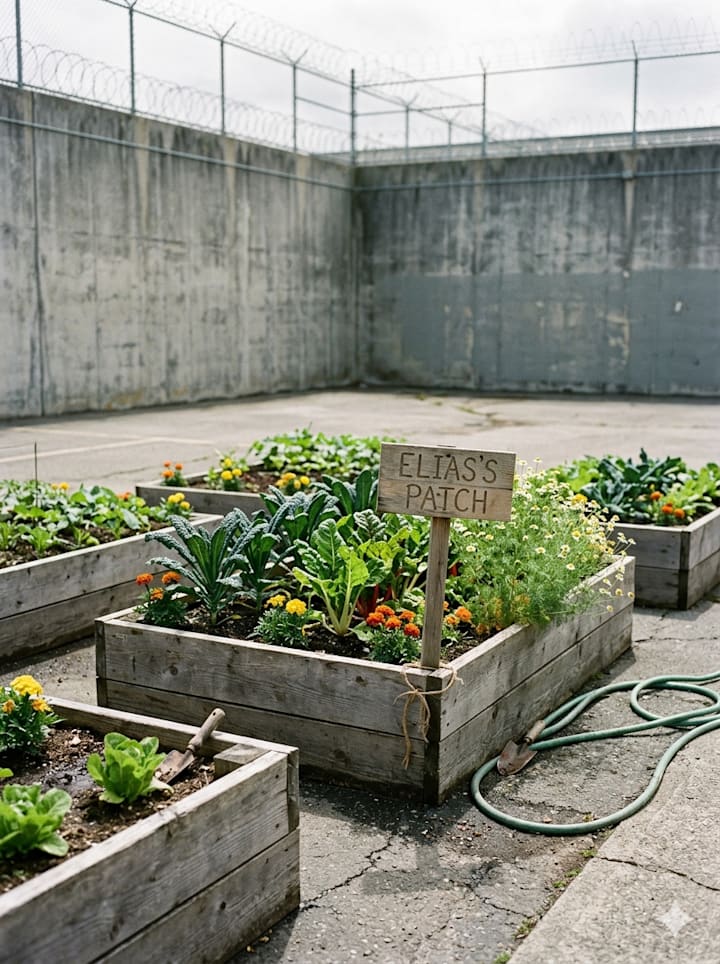
Elias found his purpose in the "Dead Zone"—a small, patch of dirt in the exercise yard that even the prison weeds had abandoned.
Every day, during his one hour of sunlight, Elias didn't lift weights or trade cigarettes. He knelt in the dirt. He used a plastic spoon he’d smuggled from the mess hall to turn the soil. He spent weeks filtering out the glass shards and cigarette butts.
"What are you doing?" a guard named Halloway asked, tapping his baton against his palm. "Nothing grows here. The soil is poison. Just like this place."
"The soil is just tired," Elias replied, not looking up. "It’s been stepped on for years. It just needs reminding, that it can be something else."
He had no seeds, so he used what he had. He saved apple seeds from his lunch, dried the pits of plums, and the sunflower seeds from his snacks; he made due.
He was building a garden. A memory of what he lost, recreated in the machine that was meant to break him.
Six-months into his sentence, a letter from Sarah arrived.
With the letter, was a photograph of a small, green sprout pushing through a crack in the sidewalk across from The Zenith.
Written on the back: Elias, The Veins are Still Here!
Elias held the photo against the cool concrete of his cell. He realized then that his "loss" was just a dormancy. Marcus and Silas had won the battle, but they could never own the subterranean pulse of the people.
Dear Elias,
I’m sitting on the bus bench—the one near what used to be the north plot. The air is different today. It’s lost that sharp, diesel sting of the construction equipment, though the silence now feels heavy, like a long-held breath.
I saw the news about Marcus. They say the towers are being frozen in probate while the banks fight over his company. It’s strange. Everyone is calling it "justice," but looking at that building blocking our sunset, it doesn't feel like a victory. It feels like a scar.
But I’m not writing to tell you about the villains. I’m writing to tell you about the veins.
Yesterday, I saw Julian. He’s working at a lumber yard, near here. He’s quieter—he doesn't move with the same confidence—but he asked about you. He’s been saving off-cuts of cedar. He said, "Just in case we ever need to build a fence again." He doesn't smile, but who does.
And Maya... I saw her from a distance. She’s left the high-rise. I heard she’s working at a legal clinic, burying herself in the kind of work that protects people from the likes of Vane. She hasn't reach out. I think what she did, is a cage of its own, but she’s trying to find the key.
The garden is gone, but the earth remembers. This morning, I walked past the construction site, where they bulldozed the soil into a gray mess. In the middle of all that waste, I found a patch of wild chamomile. It was crushed, but blooming.
It reminded me of what you said: the truth is a slow runner.
We didn't win the way the fairytales end. We lost our land, our names, and your freedom. Dishonest men destroyed everything. Yet, I realize they didn't account for the persistence of the roots.
I’ll be there on visiting day. I’m bringing a thermos of that chamomile tea you like—I managed to grow some. It’s not much, but it’s ours.
Keep your hands in the dirt. Even if it's just under your fingernails.
With love,
Sarah
Silas's betrayal of Marcus reached the prison like a shockwave. When the news broke on the common-room television—Marcus in handcuffs, his empire being dismantled by federal agents—the prisoners erupted in cheers. They loved seeing a "titan" fall.
Elias didn't cheer. He stayed in the Dead Zone, shielding a tiny, fragile sapling from the wind.
"Your enemy is gone," Miller said, standing over him. "Vane's coming here; the high-security wing. You won."
Elias looked up, with his face weary. "I didn't win, Miller. Marcus didn't lose because I was right. He lost because he was hollow. "His downfall isn't my victory." "This is."
He pointed to the ground. A single, vibrant green shoot breeching the surface of the Dead Zone. It was a common-bean plant, grown from a seed he took from a meal weeks ago.
It was small. It was insignificant. But in a world of steel and lies, it was the only thing true.
Elias Thorne was never exonerated. The legal system, even after Vane’s arrest, was too tangled in bureaucracy to admit a fundamental error. He remained a "confessed" criminal, a casualty of a war that had moved on to newer, louder headlines.
But inside the walls, the culture shifted. The guards stopped mocking the man with the plastic spoon. The other inmates began to bring him things—crushed eggshells, extra water from their rations, and seeds.
The garden grew. It wasn't beautiful in the traditional sense; it was a collection of scavenged life. But it was the only part of the prison that the sun truly touched.
Elias stood in the center of his small-patch of green, the shadow of the watchtower falling across his shoulders. He was still a prisoner. Sarah was still hiding. Julian was still broken. The Zenith still stood, even if its master was three-cell-blocks away.
The consequences of greed and violence remained etched into the landscape of their lives. As Elias knelt to press his palm against the damp earth, he knew that while hate could build towers, only resilience could keep the world from turning to stone.
The Zenith was still unresolved. The loss real. But in the quiet of the Oakhaven Penitentiary, something was growing that no architect could ever plan.
About the Creator
Meko James
"We praise our leaders through echo chambers"
Keep reading
More stories from Meko James and writers in Fiction and other communities.
The Gnash Lawn
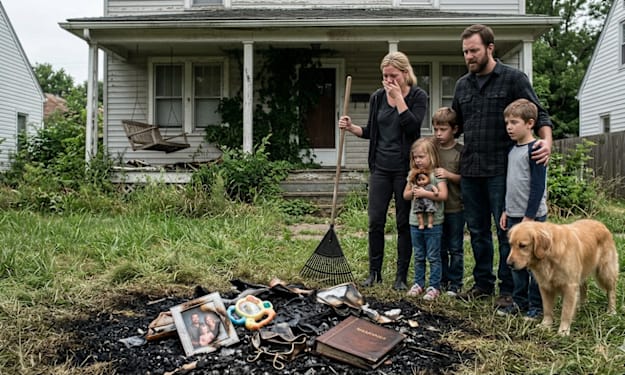
The sun over the suburbs was a cruel, mocking eye, bleaching the life out of the cracked pavement and the dying stalks of what Gary Wallace once called a lawn. It wasn't a lawn anymore; it was a battlefield of waist-high weeds and patches of dirt that looked like mange on an old dog.
By Meko James 3 days ago in Fiction
The Witch Who Rewards the Wicked
Everyone in our village knew the stories. Not the friendly ones that made children giggle. Not the tales whispered at fairs or around the fire. No—these were the warnings, the kind that left grown men shivering and women clutching their shawls.
By Mariana Farias3 days ago in Fiction
12 Life Lessons The Golden Girls Taught Us
Picture it: Miami, 1985. Four middle-aged actresses agree to play the characters of Blanche, Rose, Dorothy, and Sophia who share a home in a TV sitcom called The Golden Girls, unaware at the time of the kind of impact the show would leave on its adoring fans. The show aired until 1992, ending with a one-season spinoff called Golden Palace. The seven years we were graced with The Golden Girls on our television screens made its mark. More than three decades after Susan Harris’ imagination sparked the creation of these iconic characters, fans from around the world still watch reruns of The Golden Girls, spend time discussing the show on social media in Facebook groups like The Golden Girls Fanatics, carry Sophia-inspired handbags and relate to the episodes in their daily lives.
By Criminal Matters6 days ago in Humans



Comments
There are no comments for this story
Be the first to respond and start the conversation.